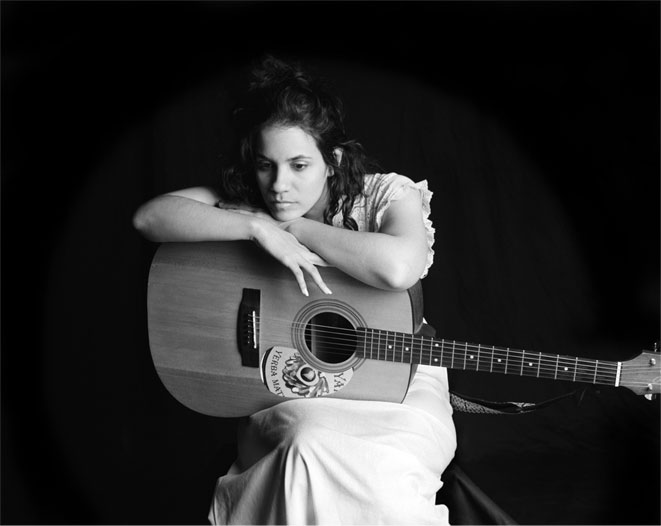
Nehedar, aka Emilia Cataldo, is an up-and-coming singer songwriter in the NYC area but not my usual blog post focus. While a fine musician and an observant Jew, her writing and stage persona isn’t obviously or easily categorized as Jewish. But Cataldo’s experience of becoming Orthodox and navigating pressures from the Jewish community (Orthodox, liberal, and secular) is well worth sharing and provides a lot of insight into the difficulties of being a Jewish musician in America.
Nehedar, which means means “wonderful” in Hebrew, writes quirky anti-folk music that puts a strong voice and guitar lead over rock, electronica, punk, and latin music instruments and rhythms. On her new album, High Tide, results vary from delicate observational moments (Tinkerbell) to anthemic anarchist screeds (Count Down The Days Til You’re Dead). I dig Nehedar but wish she’d dig a bit deeper into her lyrical material. I kept wanting to compare her to the disarming personal observations of Tori Amos and Amiee Mann, or the cynical world weariness of Firewater or the Pogues. Her lyrics, though, are a bit too shielded and externally focused. That makes them come across a bit superficial.
Here are the tracks from High Tide. Check 'em out and see what you think. Definitely worth a listen. For more info on Nehedar and High Tide, check out her
website.
As Nehedar and I were emailing back and forth I decided a more formal interview might be a good way to get share her story and she graciously obliged.
Teruah: This is a Jewish music blog so we’ll talk both music and religion, but let’s talk music first. You’ve been active in the NYC singer songerwriter scene for a while and have got a new CD “High Tide” out. In your Pens Eye View interview you were asked about your style and said “I play with genre so much that it is pretty hard to define (my sound). Anything from electronic, punk, folk, rock, and then I’ll throw in Latin beats. Then my tonal approach will vary from sarcastic to dead serious.” From my listen to the HIgh Tide, that sounds right on. I think, though, it's fair to say that the songs on High Tide are very voice and lyric centered and give the audience the experience of listening to you singing to directly to someone standing just a bit offstage. Lots of “you” in the lyrics. So, who are you singing to?
Nehedar: The you’s on this record are everything from me, to the listener, a lover, a robot, society in general, hashem.. fantasy characters...
Teruah: There’s mix of instruments across the tracks, which range from voice and strummy guitar to rock arrangements to heavy electronica. What are you playing yourself and are the other instruments your regular band or are they friends borrowed for the album? How does this compare to your live show?
Nehedar: I play most of the guitars and electronic keyboard riffs, I have preferences for certain basslines that I write. I work with producer Craig Levy (Little Pioneer) in his Brooklyn studio. He also plays bass and drums and some guitars and keys. The band is a separate entity. Only a few songs in my past 5 albums had actual live band members on the recording, but none on this album. The trumpet on "Take It Apart" is the amazing Mike Shobe who is in the band on Louis C.K's show. He's fantastic and his solos make me very very happy, but he's a session player and if I perform this song live, it will be with my friend Dan Wagner of the Long Island band "Penguin Revolution."
Teruah: The reviews I’ve seen of High Tide (
Brooklyn Rocks,
LyricLounce,
Jamsphere,
PensEyeView) were pretty positive, but what’s up with that
Heeb magazine post? Chicky (from
HipsterJew) had some snarky fun busting on your song “The Song No One Hears.” Honestly, I have little use for Heeb magazine, their music writing in particular, but even for them that was petty. Did you see that one coming?
Nehedar: I don't think he knew what he was doing. I'm fairly certain that he was assigned a comedy hit piece. I actually acquiesced to be "made fun of" in order to get some coverage in Heeb, but I assumed that it would be by someone who is familiar with writing about music. It was totally my fault for assuming that. That writer didn't even hurt my feelings because he was so dumbly dismissive. If he had actually analyzed my work (at all!) and found it lacking then I would care more. It's so important to remember not to care what any critic says though! I hope I can get to that point, whether it's a compliment or an insult, to remember their only purpose is to help you spread the word. The fact is that I got a lot more positive attention via the comments in that piece. At the end of the day Chicky was more insulted by that whole fiasco than I was.
Teruah: When we started emailing, you mentioned that you’re a shomer shabbas Jew and that you got your start playing gigs with Jewish themed music groups Pharoah’s Daughter and Jake Marmer's Mima'amakim. How did that hookup happen?
Nehedar: Jake Marmer was a friend and Mi'ma'amakim was an alternative poetry journal that he started. They had great launch events where their writers would read their poetry and there would be fantastic music: Pharoah's Daughter, Raquy & the Cavemen, Pitom, Jon Madoff, that sort of thing. I guess he just saw something in me that made him want to put me on the stage!
Teruah: One thing that gets debated is how much there is, outside of the Orthodox / Chassidic community, a Jewish music scene. What do you think? Were you playing in a Jewish music scene? What about now?
Nehedar: To me, there is very much of a Jewish music scene, but I'm not sure about the distinction of religious vs. secular. I think it's more of a matter of affiliation and friendships. Some of the most religious people are in the least religious seeming bands and vice versa but I won't name names!
My first couple of shows were with Mi'ma'amakim and then I got my stage legs steady by performing at a weekly event called Hasids meets Hipsters where the amazing Sway Machinery were regulars. My band members have all been Jewish (except my dad!), and many went on to form their own bands (Glaser Drive, Stolen Brown Evergreen) We used to play shows together for years...
I've produced shows in NYC with Rav Shmuel, Y-Love, Aliza Hava, BlanketStatementStein (Back from the UK), Mick Lewis & the Fine Print, and played at shows with Sarah Aroeste, Chana Rothman, Jezzy & the Belles, and on and on. I had a good friend and roommate in college from Moshav Modi'im (the Carlebach yeshuv) I got to know all sorts of young Jewish musicians, some of whom are still active. When I first started playing live, I had the amazing Hayyim Danzig of Blue Fringe as my bassist, and this was at the peak of their popularity - he's on a couple of tracks on my first album! So yes, I think there is a scene in NYC at least, it might need a little watering now, but it's got strong roots!
Teruah: How’s it been juggling the pressures of being a gigging musician while also being an observant Jew? Are your fans aware of this? Has it created any positive or negative expectations you’ve had to deal with?
Nehedar: It's really hard. Really. I think the hardest part for me is that, there is very little opportunity to get bigger using the mainstream networks that are in place (festivals, conferences, events etc) without performing on Friday night. If someone contacts me about performing at their event, that event will usually be on a Friday. I don't really get asked to play at Jewish scene events. I also have limited opportunity to network and support other musicians in the mainstream world (either supporting them onstage or off) because so many important shows are on Shabbat. I end up in a double bind with this situation, I am too religious for the mainstream path, and not religious enough for the Jewish track (also the wrong gender).
Teruah: How about the religious community? Liberal Jews often don’t get the idea of observant Jews who aren’t cloistered inside the ultra-Orthodox / Chassidic world. And that world often doesn’t get how someone could be a Jewish musician who isn’t Torah oriented all the time. And then there are the religious limits including kol isha and sefira to deal with. How do you navigate all this?
Nehedar: Truthfully I don't navigate it well, it's all very awkward. As you can tell I haven't made any kind of peace on this issue. I strive to be good at what I do, and true to what I believe. Kol Isha is bad news. I think it's flat out incorrectly followed and understood. Addressing this is so low on the priorities (or maybe the opposite of the priorities) of anyone with any power in mainstream leadership that I don't think we'll see a change any time soon. I will be writing a guest blog on
Jewesses with Attitude this month that addresses this perspective in greater detail. I thank G-d that there are rebbeim like Rabbi Avi Weiss, Rabbi Saul Berman and schools like Drisha and Yeshivat Chovovei Torah here in NYC that look at orthodox Judaism with a progressive lens. I was fortunate to attend Yeshiva University and to have been taken in by a wonderful modern orthodox family in 1999. Without them I would have believed the party line and thought that uttering a sentence like "I'm supposed to nullify my own mind to the torah" actually make me sound AWESOME. My Yeshiva University education provided me with some historical context of our culture's development which helps to put it in perspective. One great class with Rabbi Hidary (I forget his first name) in Yeshiva University taught me so much about the 2nd temple period including the development of the babylonian talmud that I wonder, If people were aware that the lifestyle of the Jews in Bavel was closer to modern orthodox than so called "ultra orthodox," how would that change or improve things? People learn Gemara, they don't tend to learn about the culture in Bavel from a historical perspective.
As a musician, I'm permitted to perform on Sefirah, but I won't plan a big event in NYC during sefirah out of respect for my fams (a term lovingly borrowed from NYC band Fifth Nation).
Teruah: Are you FFB (Frum from birth) or bal teshuva (came to Orthodoxy later in life)? I’m guessing the latter, right?
Nehedar: I came from a biracial nuclear family with no culture other than itself. When I chose to be orthodox, it was mainly because I needed the discipline and guidelines. My parents intentionally raised me without any boundaries or any culture to glean from (other than their counter culture). So I'm surprised, when you ask, how my music is Jewishly relevant, how much I want to have a real answer. I want to say that as a student of Jewish mysticism, I infuse my work with mystic concepts, I want to say that since my social identity is orthodox, I write from A Jewish Perspective, or that when, in a song, I am begging for help or for guidance, that I'm addressing a concept of G-d that is informed by Jewish teachings. But I don't know how much that stuff matters. If Jewish people want to see Jewish culture being very very Jewish, with bagels, lox, klezmer, etc. I will never be that because I don't want to be that. If I tried to do that kind of thing it would be false and I don't intend to spread more false messages in the world.
Teruah: I totally get that. The Jewish world is pretty segmented with each segment having its own set of expectations for music or art that is “Jewish.” In the last week I chatted with an Orthodox musician trying to convince him that Jewish music can be more than music that directly praises God (e.g. another interpretation of the Psalms) and talking with some secular “bagel” Jews who love klezmer bands and Israeli pop bands because, since the musicians are Jewish and the music has a cultural connection, the music makes them feel Jewish without asking them to deal with religion. Situating yourself in all of that is tough, not doubt.
Speaking of Jewish community reaction, in our first email you lamented that the Jewish hipsterati pretty much ignore you. I’m sympathetic, the contradictions of your life as a gigging musician and observant Jew peak my interest and should theirs, but I’d also like to challenge you a bit there. Like most Jewish American musicians, but unlike Pharoah’s Daughter or Jake Marmer, you’ve made the perfectly reasonable choice of not having your Jewish identity be central to your music or stage identity. Why should the Jewish hipsters, who are looking for ways to more publicly navigate their own Jewish identity, connect with you? What do you think they’re missing?
Nehedar: When I referenced "Jewish Hipsterrati" I was speaking more to say, Heeb, and the like who will write a long honest musical review of Yael Meyer (her mainstream identity is no more Jewish than mine), for instance, but will approach a review of my music with utter distain. I don't have illusions that I'm as Jewishly relevant as (the uber Jewish artists I enjoy like) Golem or Sarah Aroeste, but if I were to become successful, you know the mainstream Jewish publications would eat up my story with a spoon.
I guess I just wish that more people were like you, intellectually curious, and open to new things. I don't know if anyone's life is missing the presence of Nehedar music. But they won't know unless they check it out for themself and, personally, I have a lot to say and I'm tired of talking to myself!
Teruah: I get that. I’ve lamented a number of times that there are few magazines or websites that are interested in exploring what it means to make Jewish music or to be a Jewish musician regardless of how those things are defined. Since so much of Jewish life is establishing our Jewish identities in a complex secular and religious world, it’s frustrating that most magazines/websites seem to just pick their default definition, fawn on anything within it and marginalize anything outside it.
And I agree...I hope more folks in the Jewish world check out your music.
Before we wrap up, any additional info you’d like me to pass along? Any upcoming gigs we should know about?
Nehedar: Thank you so much Jack! I'm playing in Milwaukee, Wisconsin at the Circle A Cafe on Sunday July 22 at 9PM. I'll be accompanied by my dad on Saxophone and will be dressed in costume and shooting a music video that night with the audience!




 Posts
Posts

